
Making personalisation useful from the first interaction
2025-2026, Booking.com
I led the design vision for personalisation at Booking.com, defining how travellers share preferences and see them reflected across the platform. I aligned Search, Homepage, Identity and Marketing around a shared direction, then recommended pausing when the available launch could not deliver the value users expected.

Understanding travellers beyond their booking history
Travel can be irregular, and the next trip may look nothing like the last. Behavioural history alone could not reliably tell us what someone needed. Explicit preferences offered a way to understand needs that previous bookings and existing search controls did not capture.

Giving travellers control over how preferences shape their results
Five phases of research told us that travellers were willing to share travel preferences when the benefit was clear, and if they retained control.
I used this finding to shape the experience with the following principles: make sharing enjoyable, connect shared preferences with behavioural signals, explain recommendations, and deliver value without interrupting trip planning.

Separating permanent preferences from trip-specific needs
Some needs stay consistent; others change between a business trip and a family holiday. I designed account-level preferences alongside contextual profiles, letting travellers decide which needs belonged where.
The same architecture supported people with a few firm requirements and those who wanted to share more detail. I also explored sharing preferences between travel companions for trip planning.
The go-to-market proposal simplified the experience to account-level preferences while preserving a path to the richer model.

The proposed model supported account and trip profiles; go-to-market scope focused on account-level preferences.
Moving preference setup out of search to reduce mental load
Early prototypes asked travellers to set up their preferences while searching for a stay. Research showed we were asking them to do too much before they understood the benefit.
I moved the introduction into a separate onboarding experience, leaving a compact control in search to create or apply preferences. Around seven questions were enough to start tailoring the experience without making setup feel like work.
Making complex preferences easy to express
I explored direct questions, swiping, travel personas, AI-assisted input and preference suggestions to understand how people could communicate both common and niche needs, and update them as their plans changed. The challenge was to collect useful information without making people work through an exhaustive questionnaire.
Alongside these interactions, we developed a taxonomy using card sorting, customer needs, stakeholder requirements and hypotheses. It recorded the preferences, input types and business ownership needed to support the system across teams.

Exploring free-text preference input.
Sorting rather than filtering to avoid hiding potential matches
Travellers worried that preferences would hide options they might otherwise choose, as filters already did in search. I designed the experience to bring relevant options forward while keeping everything available.
People could see how well a property matched their preferences and adjust them in context if they no longer reflected their needs. They could also turn preferences off to compare with the original results.
I used plain-language descriptions rather than percentages to make relevance easier to understand without implying a precision we could not substantiate.
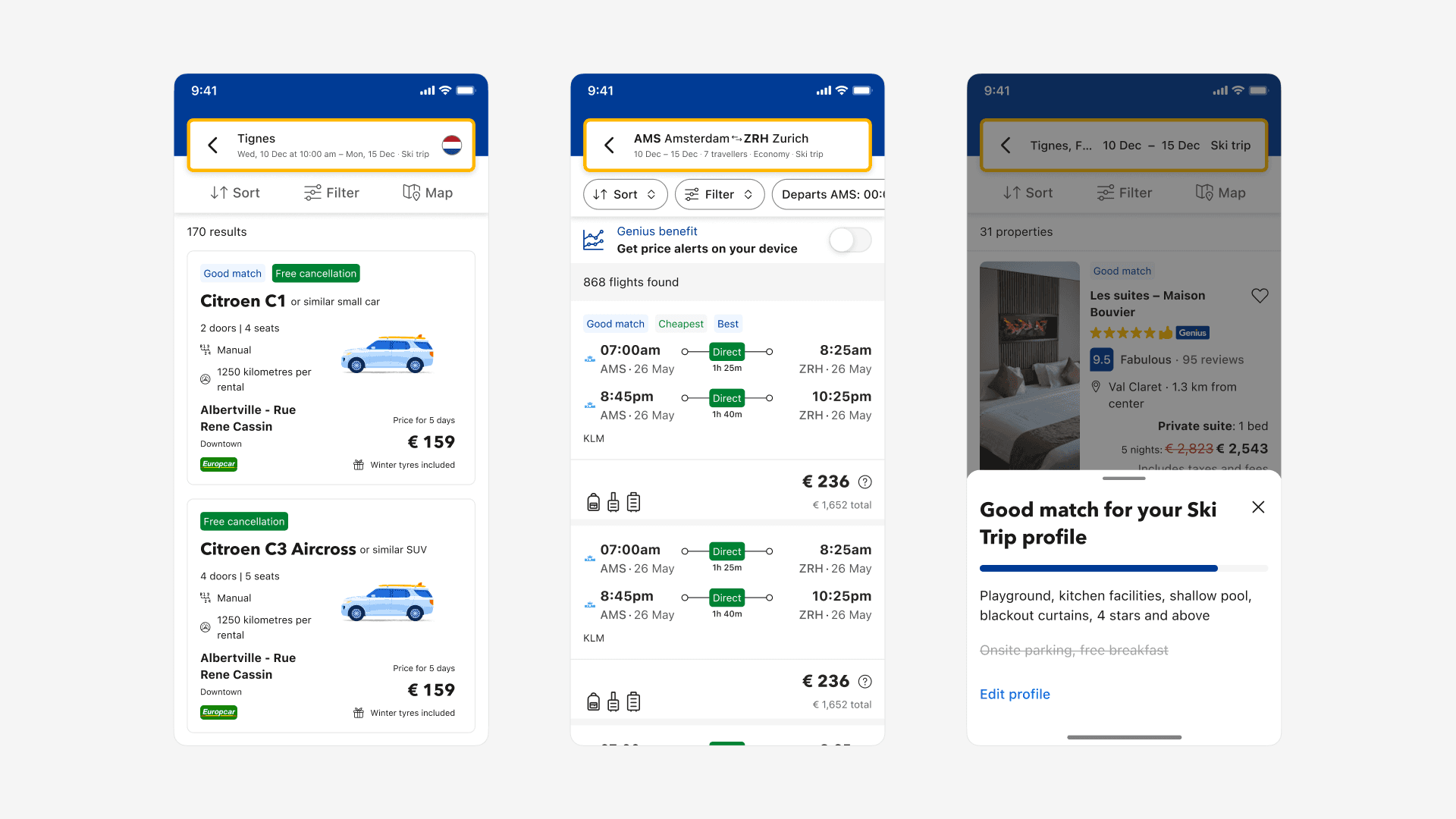
Aligning teams around a preference system that could scale across Booking.com
The system needed to work across independently owned surfaces. I used workshops, fortnightly reviews and leadership presentations to align partner teams around the vision, incorporating their requirements and feedback as the work developed.
I designed reusable relevance labels and explanation sheets for different product cards and contexts. Working alongside trip-planning and future-search initiatives helped keep the architecture compatible with their evolving experiences.

Recommending a pause when the launch risked breaking user trust
When our Search partner withdrew, the proposed launch narrowed to using preferences for marketing emails. Research showed that travellers expected their preferences to improve search results immediately. I recommended pausing rather than asking people to invest time and share information without delivering that benefit, risking their trust. My product partner and senior product director agreed.
I handed over the vision, research, prototypes and architecture, with two proposed routes back into experimentation: homepage recommendations and saved search filters. Restarting meant securing a partner who could turn shared preferences into immediate value for travellers.